
Birth Chart Explained: A Beginner’s Guide to Natal Astrology
Learn how a birth chart is calculated, what the Sun, Moon, Ascendant, planets, houses and aspects mean, and how to interpret them responsibly.
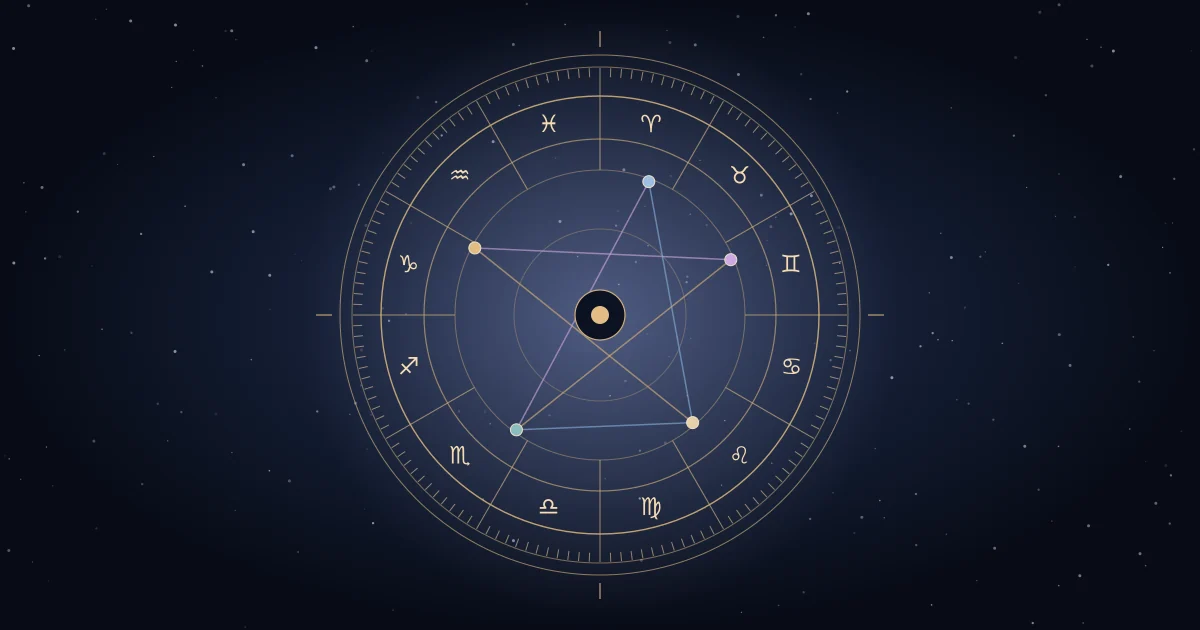
What is a birth chart and how does it work?
A birth chart, also known as a natal chart, is a representation of the apparent positions of celestial bodies at a specified moment and location. In Western tropical astrology, the zodiac is divided into twelve equal sectors of thirty degrees, beginning at the March equinox. The chart places the Sun, Moon and planets within that coordinate system and usually adds a horizon-based framework. It is useful to distinguish this mathematical description from the symbolic meanings that astrologers attach to it.
The positions can be calculated and checked against astronomical data; personality interpretations are a separate cultural tradition and are not established scientific findings. A circular diagram makes the relationships easier to see, but the underlying numerical values matter more than the decorative design. For a first reading, look for the date and location used in the calculation, identify the zodiac system, and check whether house placements are based on a reliable birth time. These details establish the context of everything else that appears in the chart.
What information does a birth chart calculator need?
A natal chart calculator generally requires your birth date, local birth time and birthplace. The date establishes the approximate positions of the Sun and the slower-moving planets. The time is particularly important for the Moon, the Ascendant and the division of the sky into houses. A city name helps determine geographic latitude, longitude and the applicable historical time zone. Local clock time cannot simply be treated as Universal Time: historical daylight saving rules and political changes may alter the conversion.
If your birth certificate records a time, use it rather than a guess, and check whether the format is twelve-hour or twenty-four-hour. When a birth time is unknown, an approximate chart can still describe some planetary placements, but it cannot reliably determine the Ascendant or houses. The Moon may also cross a sign boundary during the day. A responsible calculator should communicate that uncertainty instead of silently substituting noon and presenting the resulting house positions as facts. Avoid sharing your exact birth details unnecessarily with third parties.
Sun sign, Moon sign and rising sign: what is the difference?
The Sun sign identifies the zodiac sector containing the Sun at the time of birth. It is the placement most commonly used in general horoscopes, partly because it changes slowly enough for a date-based classification to be convenient. The Moon sign describes the Moon's position, which changes much faster and may require an accurate time to distinguish neighboring signs. Within traditional astrological interpretation, the Sun is associated with identity and intention, while the Moon is linked with emotional rhythms and habitual responses.
The rising sign, or Ascendant, is the zodiac degree crossing the eastern horizon at the chosen time and location. It is not another planet and cannot be derived from a person's appearance or temperament with astronomical precision. Astrologers traditionally associate it with first impressions and ways of approaching unfamiliar situations. Treat these three descriptions as different symbolic perspectives rather than competing diagnoses. A useful exercise is to compare them with your own observations while allowing for experiences that contradict the interpretation.
The role of planets in a natal chart
Planetary positions provide additional layers of symbolism in Western astrology. Mercury is traditionally connected with communication and learning, Venus with values and attraction, and Mars with initiative and conflict. Jupiter is associated with expansion and meaning, while Saturn represents boundaries, commitment and responsibility. Uranus, Neptune and Pluto are often interpreted through broader patterns of change, imagination and transformation. The slower planets remain in a zodiac sign for relatively long periods, so sharing one of those placements with many people is entirely expected.
A planet's sign describes the symbolic style assigned to its expression; its house and aspects provide different contextual information. Retrograde motion means that a body appears to move backward in geocentric longitude from Earth's viewpoint. It does not mean the planet physically reverses its orbit. When reading a chart, record the actual degree and sign before looking at interpretive keywords. Avoid assigning moral worth to any placement: symbolic language can support reflection, but it cannot establish a person's character, abilities or future behavior.
Understanding the twelve astrological houses
Houses organize a chart into twelve symbolic areas of experience. Common associations include personal presentation in the first house, resources in the second, communication in the third, home in the fourth, creativity in the fifth and routines in the sixth. The remaining houses are traditionally connected with partnerships, shared resources, learning or travel, public roles, communities and private reflection. These associations vary across schools of astrology and should not be confused with measurable outcomes. The method used to divide the chart matters.
Whole Sign houses assign one complete zodiac sign to each house, starting from the sign of the Ascendant. Equal House systems use thirty-degree divisions measured from a selected reference point, whereas quadrant systems such as Placidus use different geometric relationships. A planet can therefore appear in different houses in two charts generated from identical birth information. Before comparing interpretations, establish which method each tool supports. At extreme latitudes, certain house calculations can have additional limitations. If your birth time is uncertain, focus on placements that do not depend on the horizon.
Aspects, angular distances and retrograde indicators
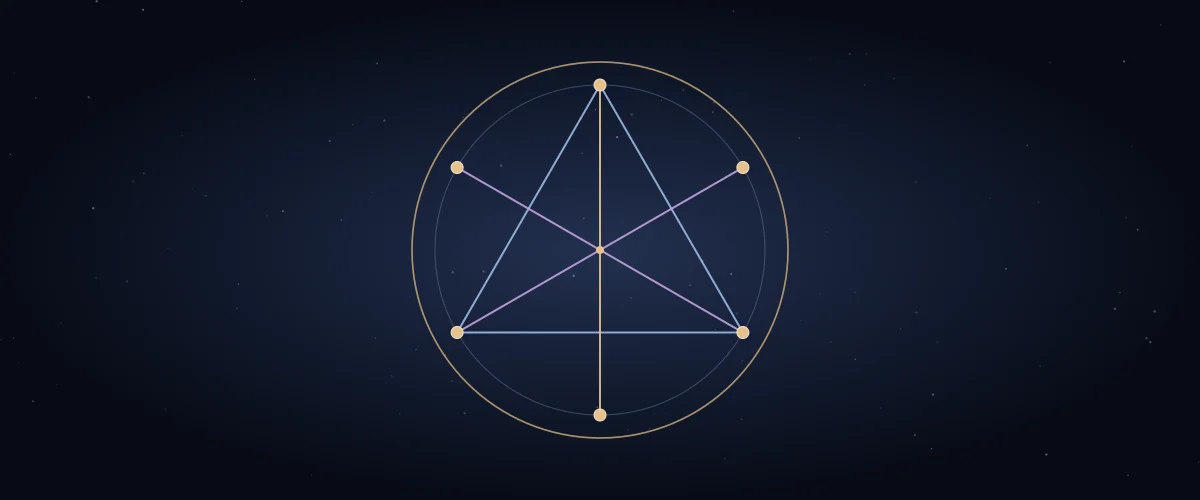
Aspects describe angular separations between two positions in the chart. Traditional major aspects include conjunction at zero degrees, sextile at sixty, square at ninety, trine at one hundred twenty and opposition at one hundred eighty. An orb is the permitted difference from the exact angle, and conventions for its size differ among astrologers. A chart can therefore display different aspect lists depending on the selected orb rules even when planetary coordinates are identical. For example, positions at ten degrees of Aries and twelve degrees of Libra are separated by approximately one hundred eighty-two degrees, which may be counted as an opposition under a two-degree orb.
The shortest angular distance should be used when positions straddle the zero-degree boundary. Astrological interpretations often describe aspects in terms of tension or cooperation, but these are symbolic categories, not physical forces acting on personality. Retrograde indicators are another separate calculation and should not be confused with aspects. When interpreting several relationships, begin with the most clearly defined ones rather than attempting to explain every line at once.
How to read your chart responsibly and avoid common mistakes
Begin with a small set of verified placements rather than a list of predictions. Write down the Sun, Moon and Ascendant if the birth time is known, then identify a few planets and their houses. Check the chart's zodiac and house system before comparing it with another website. Keep a distinction between observations that can be tested, such as a planet's position on a particular date, and interpretations that depend on a symbolic framework. A journal can help you explore whether a theme is personally meaningful, especially if you deliberately record counterexamples as well as apparent matches.
Avoid treating a favorable or challenging placement as a guarantee of relationship success, illness, financial gain or career failure. For decisions with serious consequences, rely on qualified professionals and verifiable evidence instead of a horoscope. Birth charts can be approached as cultural history, a creative language or a reflective exercise. Their value in those contexts does not require claiming that they predict events. Return to the original calculation whenever you notice contradictory readings, and keep your personal information private.